Olena Morenets
The project “Smelling New Worlds” investigates the olfactory dimension of early modern English travel writing. Its central texts are Richard Hakluyt’s Principal Navigations (1598–1600) and Samuel Purchas’s Hakluytus Posthumus (1625), among other discovery narratives. Drawing on travel writing scholarship and the history of smell, the project treats a scent as holding three tenses at once – what earlier accounts promised, what the traveller describes, and what it might fetch. Smell is layered in space as in time: the thesis gives a chapter to each of four recurring smellscapes – the wilderness, the sacred, the marketplace and the household. The following questions are at the core of my research:
- How can we identify an “olfactory scene” or a “smellscape”, and what do these notions entail?
- How did early modern writers use smell to convey the ineffable or the foreign?
- How does power decide who smells and who is smelled?
Olfactory descriptions, I contend, were not ornamental but rather marked religious and cultural difference through aromatic othering, and shaped who could claim knowledge of a place. Smellscapes and olfactory scenes became epistemological tools of discovery, and what was strange abroad was naturalised at home, absorbed into medicine, cookery and lasting olfactory heritage.
The Wreck of the Birkenhead, 1852 (print), Charles Edward Dixon. Image Credit: National Maritime Museum, Greenwich, London.
https://www.rmg.co.uk/collections/objects/rmgc-object-153363
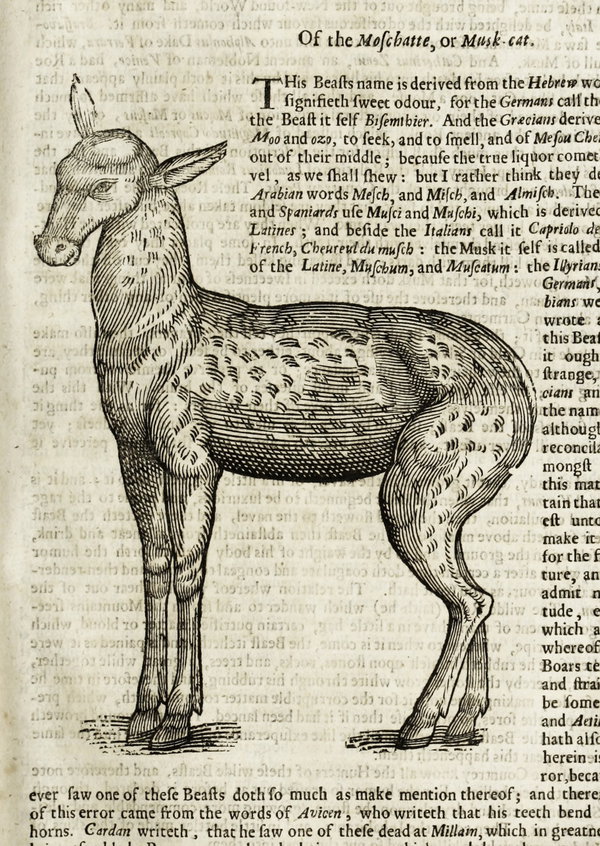
Edward Topsell, “Of the Moschatte, or Musk-cat”, The Historie of Foure-Footed Beastes (London, 1607). A deer filed among cats because of what it produces. Musk reached England along the eastern routes these accounts describe, and ended in English sweet bags.